
Two gold wedding rings on a contract being signed by a person, with a couple seated nearby.

Prenuptial Agreement Attorney in Virginia

An Agreement Signed Before the Wedding Can Save You Years of Litigation Later

A prenuptial agreement doesn’t predict divorce. It just decides, ahead of time and while both people are thinking clearly, how property, debt, and support would be handled if the marriage ever ended. In Virginia, that agreement is governed by the Premarital Agreement Act under Va. Code § 20-147 et seq., and it has to meet specific legal standards to actually hold up years later. AC Rieman Law drafts and reviews prenuptial agreements for Virginia clients who want that protection done right the first time.

    What a Prenuptial Agreement Actually Covers

    The Legal Standard for Enforceability

    Virginia’s Premarital Agreement Act requires a prenup to be in writing and signed by both parties, and it takes effect upon marriage, not upon signing. Beyond that formality, enforceability comes down to two things: was the agreement entered voluntarily, and was there fair disclosure of each party’s financial situation before signing. An agreement signed the night before the wedding, under pressure, with one spouse having no real idea what the other owned or owed, is exactly the kind of prenup that gets challenged and sometimes thrown out.
    That’s a real tradeoff worth naming honestly: a prenup drafted and reviewed months before the wedding, with full financial disclosure on both sides, is far more likely to survive a challenge than one rushed together at the last minute. Timing isn’t just a courtesy to your future spouse. It’s part of what makes the agreement enforceable.

    What Should Actually Be In It

    Common terms in a Virginia prenuptial agreement include:

    Division of property and assets in the event of divorce
    Protection of premarital or inherited property, keeping it separate from what gets divided later
    Debt responsibility, including whether one spouse’s premarital debt stays theirs alone
    Spousal support terms, including waivers or caps, within the limits Virginia law allows
    Business ownership and succession planning, particularly relevant for entrepreneurs entering the marriage with an existing company

    One limit worth knowing upfront: Virginia prenups can’t determine child custody or child support in advance. Those decisions belong to the court at the time they’re actually needed, based on the child’s best interests at that point, not an agreement signed years before the child existed.

    Who Actually Needs One

    Prenuptial agreements get stereotyped as something only for the wealthy, but that’s a narrower group than who actually benefits from one. Business owners entering a marriage with an existing company want to keep that business from becoming a divisible marital asset later. Someone entering a second marriage, especially with children from a prior relationship, often wants clarity around inheritance and existing obligations. A professional carrying significant student debt may want that debt to stay clearly theirs, not shared. And some couples simply want financial transparency going into the marriage, without any particular asset at stake.
    Business Owners Have Specific Exposure.

    A business started before marriage is separate property at the outset, but that status can erode over time. If marital funds get invested in the business, or if a spouse contributes unpaid labor to its growth during the marriage, some or all of that business can become a marital asset subject to division, even though it started as one spouse’s separate property. A prenup that explicitly addresses how business growth and marital contributions will be treated closes that gap before it becomes a dispute.
    A Scenario Worth Considering.

    Take a business owner entering marriage with a company already valued at $600,000. Without a prenup, five years of marriage during which that business grows to $1.4 million, partly through the owner’s continued work and partly through market conditions, can leave the entire $800,000 of growth exposed to division as marital property, even though the original $600,000 might be argued as separate. A prenup that specifically addresses how business appreciation will be treated, whether it stays separate, gets split by a formula, or is offset against other assets, removes that ambiguity entirely. Waiting until the divorce to argue over it means paying for a business valuation and litigating a question the couple could have simply decided in advance.

    Already Married? A Postnuptial Agreement Covers Similar Ground.

    Couples who didn’t sign a prenup before the wedding aren’t out of options. A postnuptial agreement covers much of the same territory, property division, debt allocation, spousal support terms, but it’s signed after the marriage has already begun. Virginia recognizes postnuptial agreements under similar enforceability standards, though courts sometimes apply extra scrutiny given that the leverage dynamics between spouses can shift once they’re already married. AC Rieman Law drafts both, and can advise on which makes sense if you’re past the wedding date but still want this kind of clarity in place.

    Drafting an Agreement That Actually Holds Up

    An enforceable prenup takes more than a template downloaded online. AC Rieman Law walks through full financial disclosure with both parties, drafts terms that reflect Virginia’s actual legal standards, and builds in enough time before the wedding date that the agreement can’t later be challenged as rushed or coerced. Every agreement gets built around the specific couple, not a boilerplate document with names swapped in.
    A note on timing: the earlier this process starts, the stronger the agreement. Waiting until weeks before the wedding narrows your options and increases the risk that a future court sees the agreement as pressured, even if that was never the intent.

    What Full Financial Disclosure Actually Requires

    Disclosure isn’t a formality satisfied by a general statement that both parties “have been informed of each other’s finances.” Virginia courts look for real documentation: asset statements, debt schedules, income records, and business valuations where relevant. A spouse who later claims they didn’t understand what the other person owned or owed has a much stronger challenge to the agreement if the disclosure was vague than if it was documented with actual account statements and appraisals attached as exhibits. AC Rieman Law builds that documentation into the drafting process from the start, rather than treating disclosure as a box to check right before signing.

    Each Party Needs Their Own Attorney

    A prenup reviewed by only one spouse’s attorney, with the other spouse signing without independent counsel, is one of the more common grounds for a later challenge. Virginia courts look more favorably on agreements where both parties had the opportunity to review the terms with their own lawyer, even if one spouse ultimately declines that opportunity. AC Rieman Law will draft an agreement for one party, but always recommends, in writing, that the other party seek independent counsel before signing, precisely because skipping that step weakens the agreement’s enforceability later.

    Why Work With AC Rieman Law

    Grounded in Virginia’s Premarital Agreement Act, not generic multi-state templates

    Full disclosure process built in, protecting the agreement from later challenges

    Direct access to Amanda Rieman, from the first conversation through final signature

    Comfortable representing either party, whether you’re proposing the agreement or reviewing one your fiancé’s attorney drafted

    Serving Central and Northern Virginia

    Attorney Amanda Rieman works with individuals and couples across Culpeper, Fredericksburg, Charlottesville, Front Royal, Manassas, Fauquier County, and the rest of Central and Northern Virginia. Whether you need an agreement drafted from scratch or reviewed before you sign, AC Rieman Law provides clear advice and experienced guidance through the process.
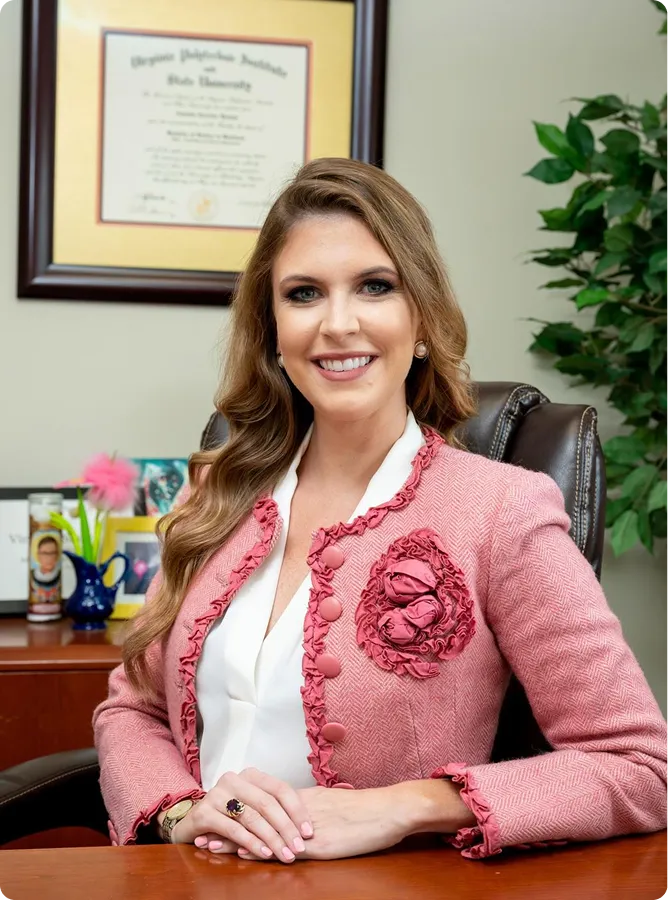
    Professional woman with long wavy hair wearing pink jacket, seated at desk with diploma and plant in background.